GSM-R, the 2G-based radio that has carried railway voice traffic for two decades, is approaching end of support, and its successor FRMCS is transitionning from the specification phase to real-world deployments with first tenders now being issued. Across Europe, railways are at very different stages of this journey: some already run trials and proof-of-concept setups, others are still extending GSM-R. Closing that gap without disrupting daily operations was the subject of an Eviden webinar with Franck Lett, the company's Global Transportation Sales Director, and Mathieu Perrus of the Infrastructure Engineering Department at Luxembourg's national operator, CFL.
Why the sunset date keeps moving?
Lett outlined four key drivers behind the migration.. GSM-R rests on ageing 2G technology with declining vendor support. FRMCS adds what the next phase of rail needs, namely digitalization, broadband, low latency and a base for automation. Cybersecurity is built into FRMCS by design, rather than added later, which matters as attacks on railways become more frequent. And the regulatory direction is set, with FRMCS recognised as Europe's future standard..Lett also highlighted its role in enabling ETCS noting that FRMCS can accelerate Level 2 deployment by providing the modern communications layer required for continuous supervision.
The timeline has shifted somewhat in a useful direction. A few years ago, the industry planned around a 2035 cutoff; vendors now indicate that long-term GSM-R support may run to around 2040 at the latest. That extra room does not make the work easier, because most European migration are brownfield projects, not a clean build, and the goal is to avoid a single "big bang" changeover.
Where Eviden fits: the service stratum
FRMCS, unlike the monolithic GSM-R, structured into a transport stratum (the 5G network) and a service stratum (the mission-critical communication services on top). Eviden focused on the service stratum, leaving the 5G transport layer to the traditional Telecom Vendors. Its MCX core delivers mission-critical push-to-talk, data and video services. This is complemented by MCX clients for Android and iOS, a browser based dispatcher, and a recording system capable of capturing and replaying voice, video, and data. Additional components include a centralised management system, an software deployment kit (SDK), and onboard equipment, such as the voice cab radio and TOBA (telecom onboard architecture), currently under development.From a procurement perspective, the architecture is fully virtualised: all components run as virtual machines on standard commercial hardware (COTS), with no proprietary appliances. A single server can host the MCX server, dispatcher, recorder, management platform, and interworking function, contributing to reduced capital and operational expenditure.
The interworking function does the hard part
The Interworking Function (IWF) bridges the MCX world with legacy communication systems such as GSM-R, TETRA, P25, DMR and PBX. During the migration from GSM-R to FRMCS, it decouples the GSM-R and MCX domains, allowing each to evolve independently while ensuring seamless interoperability. The IWF is based on open 3GPP and ETSI standards, ensuring interoperability and vendor independence.
n operation, the IWF translates between the legacy GSM-R domain and the MCX domain without changing the user experience. A GSM-R functional number is mapped to the corresponding MCX identity expressed as a SIP URI. A GSM-R group call becomes an MCX group call. A Railway Emergency Call (REC) survives the crossing, with extra the required information mapped into the the MCX side. A GSM-R text message arrives as an MCX data message. Eviden showed this running in anonymised lab screenshots, including the mapping tables that associate each user's GSM-R and MCX identities as a single operational entity.
How CFL is phasing the switch to 2027
Perrus began by outlining CFL’s operational environment. CFL runs roughly 275 km of dense, heavily used and strongly interconnected track, with significant cross-border traffic toward Belgium, Germany and France and around 1,000 train movements a day. The backbone today is about 100 GSM-R radio cells, some 80 dispatcher workstations and around 250 onboard cab radios, on GSM-R Release 4 for circuit-switched voice with very limited data.
A key factor shaping the transition is that CFL’s signalling is based entirely on ETCS Level 1, which relies on Eurobalises rather than continuous radio communication, and there are no plans to move to ETCS Level 2. As a result, FRMCS will replace GSM R for operational communications only, without impacting signalling systems.The pressure to move comes instead from GSM-R's end of life and from ageing analogue systems: shunting radios (analogue in Luxembourg), track phones and copper infrastructure, plus dispatcher systems that need adapting or replacing for MCX.
CFL’s strategy is built on three pillars:, MCX services, a 5G network covering core and radio access, and dedicated railway spectrum in the n100 (900 MHz) and n101 (1900 MHz) bands. The first proof of concept put a full MCX system in place "over the top" (i.e. over public 5G network), without negotiated quality of service, to validate the architecture and build operational know-how. Perrus reported that phase finished and successful. The second proof of concept takes on the harder problem, interworking with GSM-R, alongside interworking with CFL's Wi-Fi, a high-availability design and intense staff training. If the trials hold, a national rollout in 2027 will replace all the legacy dispatchers, and a full FRMCS upgrade follows from 2028 or 2029, aligned to the first edition of the specifications and the CCS TSI and moving progressively onto CFL's own 5G network.
What MORANE-2 is validating
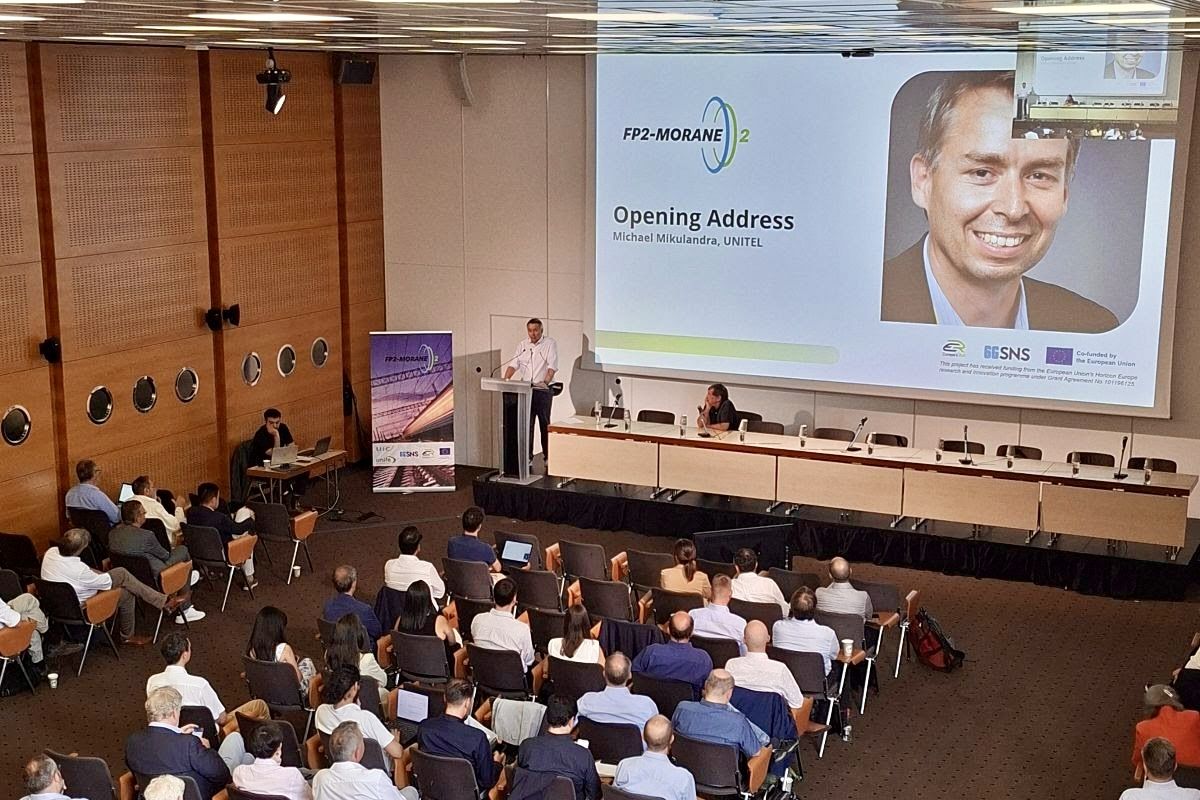
Eviden's IWF also anchors its role in FP2-MORANE-2, the programme validating the current FRMCS specification, version 2.2 plus selected version 3 candidates, to produce a stable version 3 that becomes the first edition for commercial deployment. MORANE-2 runs lab tests across three locations and field tests on five lines in four countries. Within it, Lett said Eviden is the only GSM-R interworking-function supplier for the whole programme, one of just two MCX suppliers and one of five dispatching-system suppliers. In the German field setup, Eviden provides the MCX application server and IWF, connecting to a Nokia GSM-R network subsystem and a Nokia 5G core, with field testing due to start in January 2027.
The open problem is bridging the old radios, not FRMCS itself
Two answers in the Q&A were more revealing than the slide decks. On cyber resilience, Perrus described a design of isolated system "bubbles" that can be disconnected under attack, so trains keep running in a degraded mode, with the MCX system hardened through penetration testing. On legacy radio integration, Lett acknowledged that challenges remain. TETRA's native interworking is defined by 3GPP but implemented unevenly across vendors and often tied to licences, which reintroduces the vendor lock-in was meant to leave behind. Workarounds exist, such as the ISI inter-system interface , but the industry has not converged on one approach yet.
That is the honest state of play. The FRMCS standard itself is maturing on schedule through MORANE-2; the friction sits in the brownfield realities and in bridging TETRA and GSM-R cleanly. CFL's advice to other operators followed from exactly that: start planning and testing early, because the interworking and the legacy estate, not the specification, are what set the pace.